35,00 €
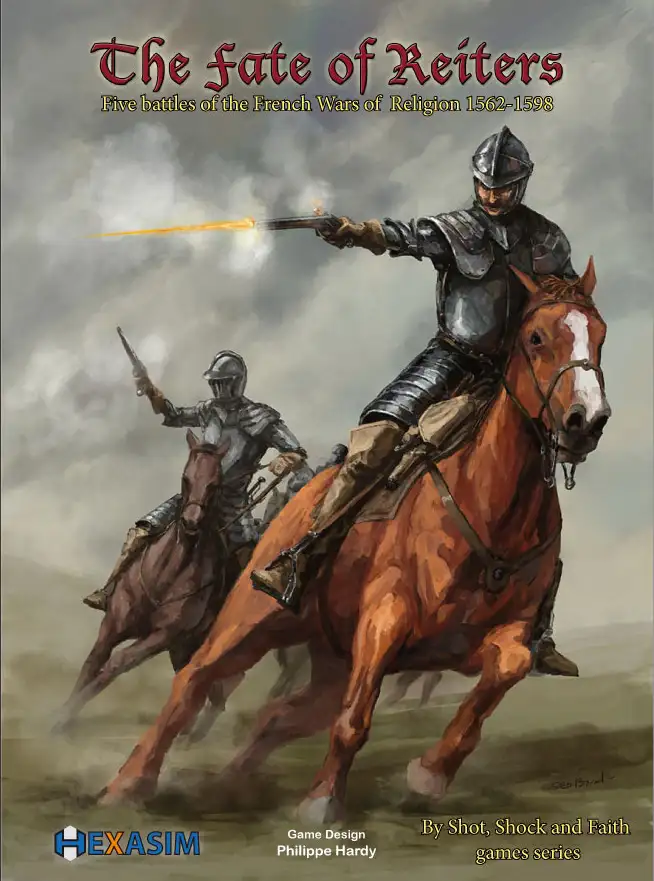
“The Fate of Reiters” is a large-scale tactical area wargame themed around the Wars of Religion that took place in France from 1562 to 1598. Volume II of By Shot, Shock and Faith series.
Description

“The Fate of Reiters” is a large-scale tactical area wargame themed around the Wars of Religion that took place in France from 1562 to 1598. Volume II of By Shot, Shock and Faith series. The combat table has been improved. More deadly, it can be used for the first game.
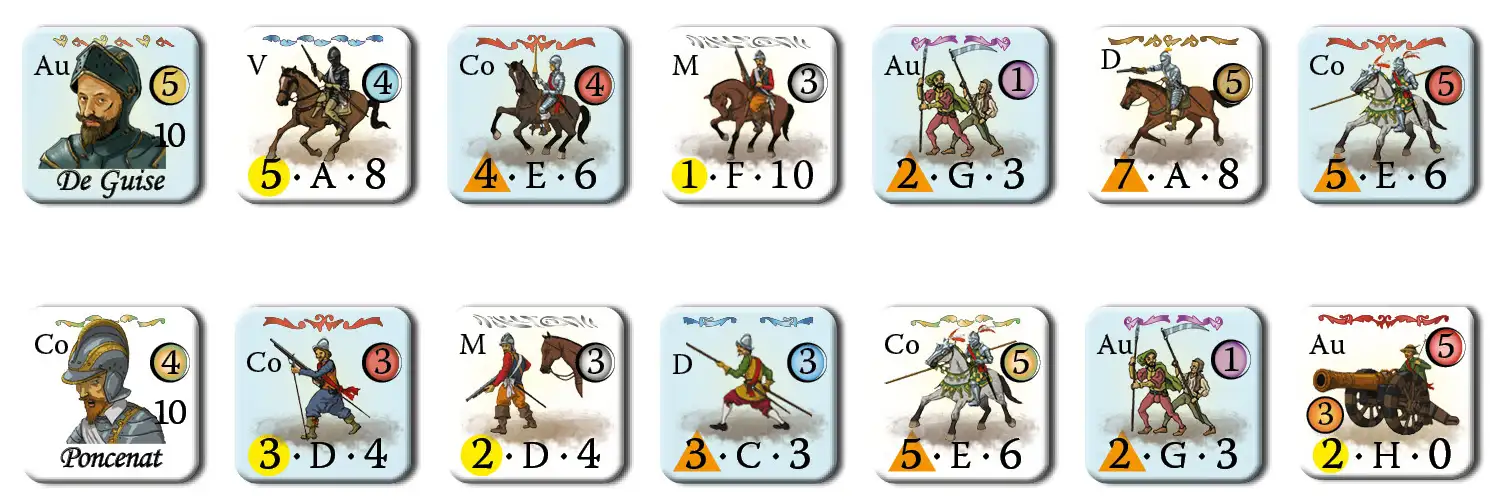
Compared to the previous version, the graphics for the counters have been redesigned to improve their readability. Now, units fighting with firepower have their combat factor represented by a yellow circle, while those fighting in melee have their combat factor represented by an orange triangle.
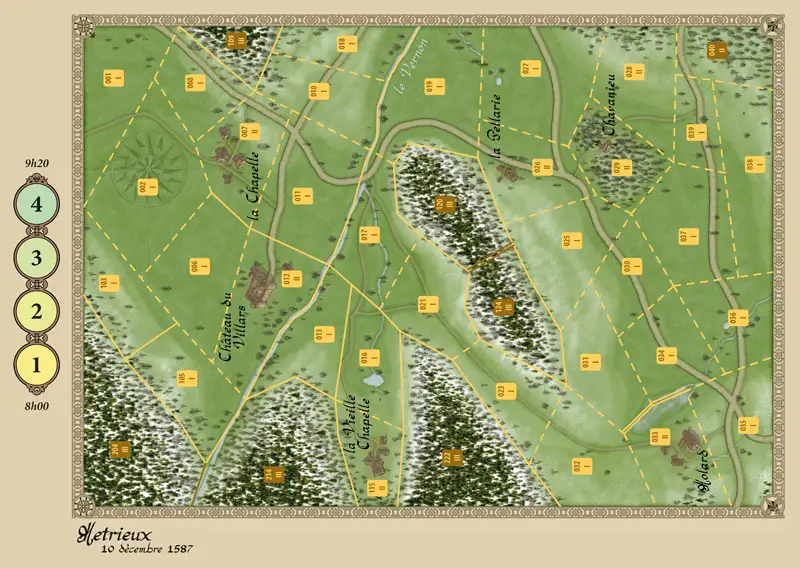
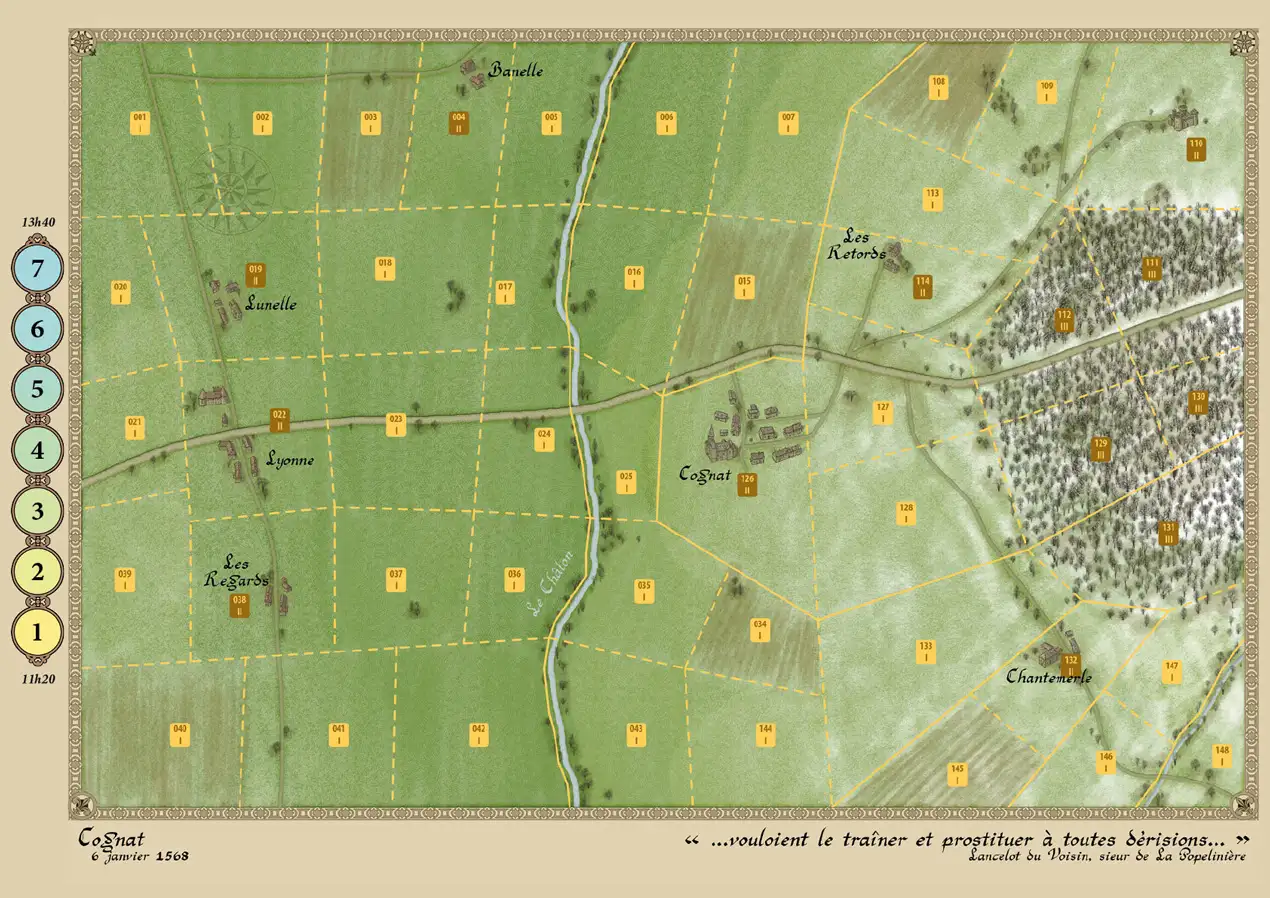
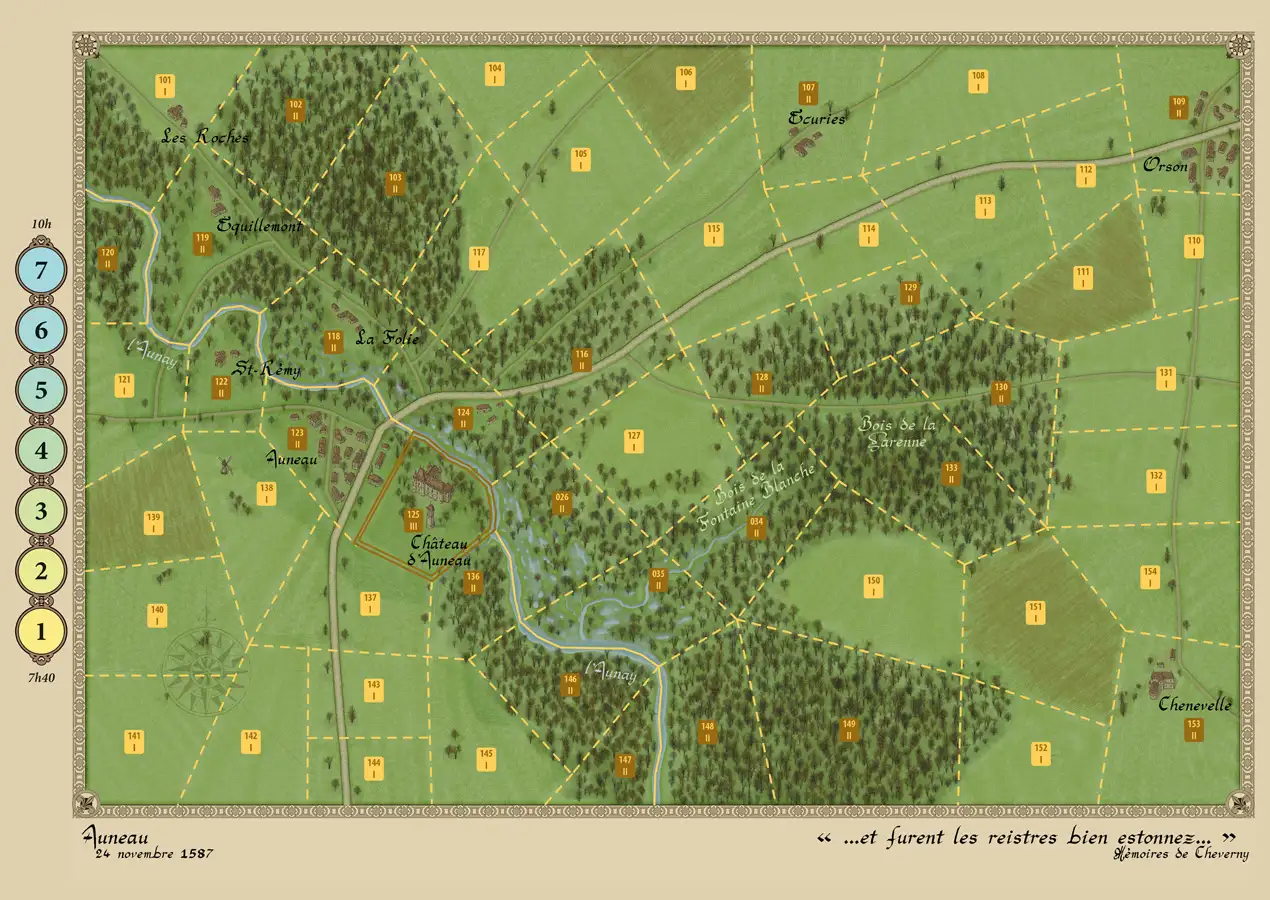
Fate of the Reiters features five battles from this period:
Cognat (January 6, 1568): A troop of Huguenots destined for Condé’s army, which is besieging Chartres, crosses the Allier River on the Vichy bridge and heads west. At the exit of the Bois de Randan, she encountered a Catholic army that had come to block her path. They crossed the Allier on the bridge which they destroyed and discovered, from the village of Cognat (at the time Cognac) slightly uphill, the Catholic army below, in the plain of the Limagne.
Dormans (October 10, 1575): A corps of German reiters, recruited by English Protestants and the Malcontents, was led by Guillaume de Montmorency-Thoré toward the army of the Prince of Condé, located in the southwest. Henri de Lorraine, Duke of Guise, led the troops of Henri III to stop these insatiable reiters, who were brazenly parading their wagons of plunder through the French provinces. Henri de Guise had massed his men on the heights overlooking the Marne near Dormans, where the Protestants were quartered…
Vimory (October 26, 1587): The Protestant troops had established their camp in several villages some twenty kilometers apart. The troops stationed at Vimory felt confident within this large deployment, and no picket line was set up; the Catholics coming from Montargis (Nord) were about to surprise the reiters…all dismounted. The proximity of other Huguenot troops and potential reinforcements forced Guise’s men to act quickly…
Auneau (November 24, 1587): On their way to cross the Loire (south of the map) and join Henry of Navarre’s army in southwestern France, the reiters stopped at Auneau. The castle being occupied by a small Catholic garrison, the reiters occupied the rest of the town. Under cover of night, the main body of Catholic troops entered the village through the castle grounds.
Métrieux (December 10, 1587): Pilat Massif, December 10, 1587: the weather is dreary and cold, the sky gray, the cloud cover low. After the defeat of the German mercenaries at Auneau against the Duke of Guise on November 24, 1587, a Protestant troop is attempting to return to its base in Vivarais with a small contingent of soldiers. This contingent comprises about one hundred cuirassiers and approximately two hundred mounted arquebusiers. Its leader is François de Châtillon, son of Admiral de Coligny. At the cost of forced marches, they have managed to keep the army of the Catholics of Lyon at bay, who have been ordered to intercept them. The men are as exhausted as the horses; they are gripped by the fear of crossing this hostile Pilat, but they believe in a small miracle that will allow them to reach their homes before nightfall. The Catholics, far more numerous, believe they can easily overcome this small band and thus seize their belongings… This small battle serves as an introduction to the system, with few counters and a small map.
This is a classic “You go, I go” game system of medium complexity, which includes, during the active player’s phase, a reaction sequence for the passive player to execute a shot, a counter-charge, or a tactical retreat.
The maps consist of zones 300 to 500 meters square. A color code allows for easy determination of movement costs and line of sight. The game scale is one unit for 100 to 500 combatants or one or two artillery pieces. A game turn lasts 20 to 30 minutes. A unit represents either an advance guard or rearguard, or the main body, called a battle.
The combat allows for the simulation of “hedge” charges, merciless clashes between pikemen, and artillery fire, and highlights, through a support system, the combination of steel (the shock) and fire (the ranged attacks). Optional rules—caracoles, orders, lost children, pillaging—add even more realism to the battles of this period.
The rules and the five battles offered are based on extensive research and a solid bibliography, drawing on works written by contemporaries, notably François de la Noue for the Protestants and Blaise de Montluc for the Catholics, as well as precise topographical surveys of each of the battlefields still accessible, except for Saint-Denis… Are you ready to don the armor of the Prince of Condé, Admiral de Coligny, the Constable of Montmorency, Anne de Joyeuse, or Henry of Navarre and fight your enemies “with fire, iron, and faith”? P3F, the new game from Hexasim, offers you this opportunity through an innovative and elegant game.
Components
- Two A2 size cards (597 x 420 mm) (both printed on both sides),
- one A3 size card (420 x 297 mm),
- 234 pre-cut 15mm tokens (2 sheets of tokens),
- a full-color rulebook (20 pages) with examples,
- player aids,
- 2 dice,
- a box.